DODigitalOptad
How we work
BlogGet Started
Home/Insights

Enterprise Systems Integration: Complete Strategic and Technical Architecture Guide

Digital Optad6 September 202614 min read
Back to all insights

Enterprise systems integration connects software platforms, operational technologies, and data repositories into a single coordinated technical ecosystem. Modern organizations cannot afford disconnected software applications, manual re-entry, or fragmented data silos. When core systems—such as Enterprise Resource Planning (ERP), Customer Relationship Management (CRM), Product Lifecycle Management (PLM), and Manufacturing Execution Systems (MES)—operate independently, decision-making becomes slow and errors multiply across every work process. We analyze how enterprise systems integration works at an architectural level, evaluating data models, interface boundary layers, messaging frameworks, and practical deployment patterns.
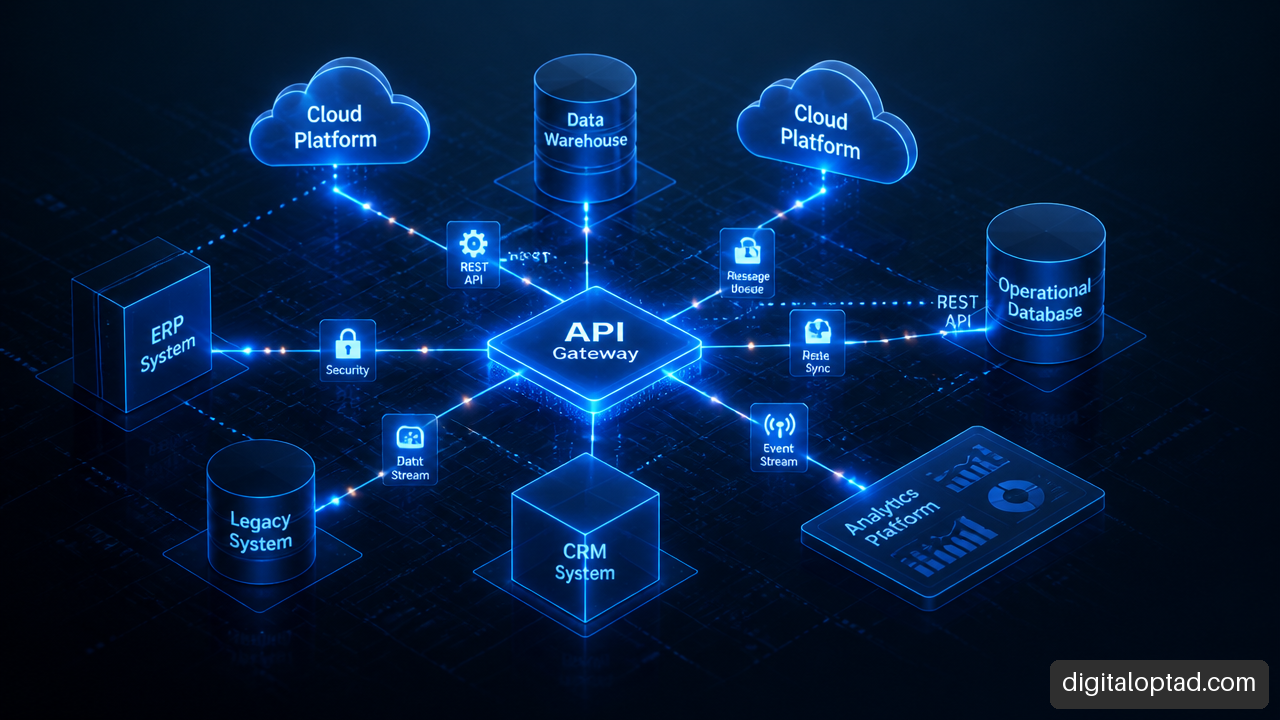
Enterprise systems integration architectural diagram showing connected software applications and databases

Table of Contents

• Key Takeaways • Understanding Enterprise Systems Integration: Architecture and Core Models • Enterprise Systems Integration vs Enterprise Application Integration • Core Architectural Patterns: Point-to-Point, ESB, iPaaS, and Mesh • Business-to-Manufacturing Transactions and Operational Workflows • Modernization, Legacy System Integration, and Risk Management • Frequently Asked Questions • Sources and References

Key Takeaways

• Strategic Alignment: Enterprise systems integration unifies isolated software environments to automate data flow, reduce manual re-entry, and eliminate data silos. • Standards-Based Frameworks: The IEC 62264-1 standard defines standard models and terminology for enterprise-control system integration and Level 3/4 interfaces. • Transactional Content: Standardizing transaction schemas between business functions and operational layers prevents broken interfaces during software updates. • Technology Abstraction: The IEC 62264-6 messaging specification defines a technology-independent messaging service model for interoperability across domains. • Architecture Selection: Choosing between point-to-point, Enterprise Service Bus (ESB), and Integration Platform as a Service (iPaaS) depends on latency, data volume, and domain boundaries.

Understanding Enterprise Systems Integration: Architecture and Core Models

Breaking Down System Interfaces and Silos

Enterprise systems integration goes beyond connecting two applications via a simple web hook. It establishes an organizational strategy for data flow, object modeling, and transactional consistency. In typical corporate IT environments, individual business units implement software solutions designed specifically for their internal mandates. Sales teams adopt CRM platforms, finance teams rely on core general ledger systems, and operational teams deploy inventory or warehouse tools. Without structural connectivity, these systems form isolated data silos.

When data silos exist, employees must manually copy records from one database to another. This manual re-entry creates data drift, latency, and frequent operational errors. An integrated architecture replaces manual steps with automated event triggers, API calls, or batch synchronization jobs. Consequently, when a customer record updates in a CRM, that update propagates instantly to accounting and fulfillment applications.

ISA-95 and IEC 62264 Standards Framework

To build resilient cross-system architectures, technical teams look to established industrial standards. The ISA-95 family, along with its international counterpart IEC 62264, provides a foundational framework for structuring enterprise integration boundaries. The ANSI/ISA-95.00.01-2025 standard describes interface content between manufacturing operations and control functions and other enterprise functions.

This framework separates systems into explicit functional hierarchy levels:

  1. Level 4: Enterprise business systems (ERP, CRM, financial forecasting, and long-term planning).
  2. Level 3: Manufacturing operations management (MES, quality systems, batch execution, and maintenance management).
  3. Level 2: Control systems (SCADA, batch control, and supervisory human-machine interfaces).
  4. Level 1: Sensing and manipulation (direct physical sensors and actuators).
  5. Level 0: The underlying physical process itself.

By establishing these boundary levels, software architects can establish clear ownership of data and transactional responsibilities across the business enterprise.

Defining Level 3 and Level 4 Interfaces

The interface between Level 3 (operational management) and Level 4 (business strategy) represents one of the most critical boundaries in enterprise technology. Business planning systems operate on high-level units, such as financial ledger codes, master purchase orders, and daily production targets. Operational systems execute on granular parameters, such as machine cycle times, individual work-in-progress status, sensor logs, and raw material weight calculations.

Integrating Level 3 and Level 4 requires mapping granular operational facts into clean, high-level business summaries without overloading corporate databases. The standard boundary definitions ensure that business systems send structured requests—such as work schedules or bill-of-materials specifications—while operational systems return production responses, equipment availability stats, and actual resource consumption rates. This structured division keeps enterprise databases clean while providing operational teams with real-time execution visibility.

Enterprise Systems Integration vs Enterprise Application Integration

Scope Differences Across Business Domains

While the terms Enterprise Application Integration (EAI) and Enterprise Systems Integration (ESI) are often used interchangeably, they refer to different strategic scopes. EAI focuses predominantly on connecting software applications within the IT domain—such as linking a cloud billing engine to an enterprise CRM or syncing HR software with single sign-on identity providers. EAI typically addresses web service protocols, JSON payloads, and RESTful APIs.

In contrast, Enterprise Systems Integration (ESI) encompasses both software applications and operational systems, physical infrastructure, database clusters, hardware controllers, and cross-departmental business processes. ESI extends into complex operational contexts, ensuring that hardware devices, industrial software, cloud applications, and third-party vendor platforms operate as a unified system. Organizations reviewing their broader platform needs often evaluate comprehensive online services to support this balance of web protocols and enterprise infrastructure.
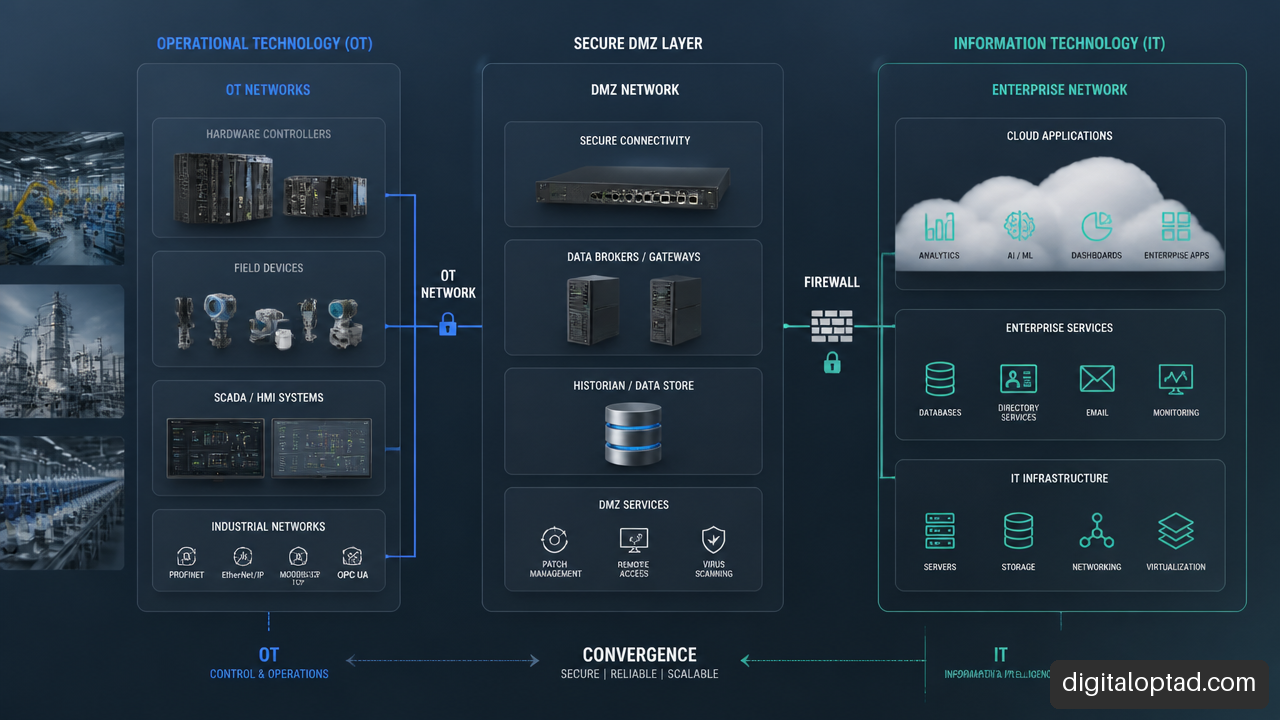
System architecture diagram illustrating IT and OT convergence boundaries in enterprise integration

Operational Technology (OT) and Information Technology (IT) Convergence

Connecting IT systems to Operational Technology (OT) environments introduces architectural requirements that do not exist in standard software integration. IT systems prioritize data confidentiality, high storage capacity, and complex transactional logic. OT systems prioritize real-time deterministic performance, high availability, and physical safety.

In IT/OT convergence, latency expectations differ fundamentally: an enterprise CRM application can tolerate a two-second latency delay, whereas an industrial controller or high-speed sorting machine must execute logic within milliseconds.

To bridge this gap without compromising physical safety or system security, integration architects build demilitarized zones (DMZs), data historians, and intermediate buffering layers between Level 3 and Level 4. These layers collect fast OT telemetry and present clean, aggregated updates to enterprise applications.

Domain Boundaries and Data Governance

Establishing governance rules across disparate business units requires defining clear single sources of truth. Without standard data governance, different business divisions may define fundamental enterprise objects differently. For example, the finance department might define a customer as an account with an active billing contract, while the customer support division considers any user with a trial login a customer.

To establish seamless integration, organizations construct a Unified Data Model or Canonical Data Model (CDM). A CDM enforces universal definitions for key business objects, including:

• Customer Master Data: Standard format for addresses, tax identifiers, and contact histories. • Material Master Data: Unified product SKUs, units of measure, and weight conversion ratios. • Personnel Records: Synchronized user profiles across security directories, payroll, and project allocation systems. • Financial Statements: Standard ledger accounts, cost center codes, and currency exchange models.

Core Architectural Patterns: Point-to-Point, ESB, iPaaS, and Mesh

Evaluating Integration Architectures

Choosing the right architectural pattern directly dictates how easily an enterprise can maintain, scale, and upgrade its software stack over time. When an organization starts small, connecting two applications directly seems simple. However, as the application portfolio grows, architectural choices determine whether the software landscape remains maintainable or turns into a fragile network of brittle connections.

Integration PatternBest Use CasePrimary AdvantageMajor Limitation
Point-to-PointLinking 2 to 3 isolated static applicationsRapid setup, low initial expenseUnscalable; creates $N(N-1)/2$ connection complexity
Hub-and-SpokeCentralized routing across medium IT environmentsCentralized monitoring and controlCentral hub becomes single point of failure and bottleneck
Enterprise Service Bus (ESB)Large-scale legacy enterprise systemsDeep protocol transformation and transaction controlComplex to maintain; heavy vendor lock-in
iPaaS / Cloud MeshModern hybrid cloud and multi-SaaS ecosystemsHighly scalable, low infrastructure overheadContinuous vendor licensing costs, internet latency dependance

Point-to-Point vs Hub-and-Spoke and ESB

Point-to-point integration connects two individual applications directly through custom scripts or direct database queries. While easy to build initially, adding more systems causes the number of direct interfaces to increase exponentially. Connecting 10 systems requires up to 45 unique point-to-point connections, creating a web of dependencies where updating one application breaks multiple downstream interfaces.

Hub-and-spoke and ESB patterns address this issue by routing all traffic through a central engine. Applications connect solely to the central engine using dedicated adapters. The central engine manages message transformation, protocol conversion, and routing logic. If an organization updates its primary accounting software, only the adapter connecting that application to the central hub needs adjustment, keeping all other system interfaces untouched.

iPaaS and API-Led Connectivity

Modern enterprise architectures rely heavily on Integration Platform as a Service (iPaaS) solutions and API-led design principles. API-led connectivity breaks down software capabilities into three distinct layers:

  1. System APIs: Low-level interfaces that unlock data from core databases and legacy applications without exposing underlying database schemas.
  2. Process APIs: Middleware logic that combines data from multiple System APIs to execute specific business workflows (such as order-to-cash processing).
  3. Experience APIs: Lightweight endpoints tailored for specific user touchpoints, such as mobile apps, customer portals, or web applications.

This layered strategy allows organizations to reconfigure business processes quickly without rewriting underlying enterprise system code.

Event-Driven Architectures and Messaging Service Models

In high-volume environments, synchronous integration approaches (such as standard REST APIs where a client waits for an immediate HTTP response) can cause system slowdowns. If a downstream database responds slowly, the calling application hangs, causing compounding delays across the enterprise.

Event-driven architecture (EDA) solves this by using asynchronous messaging. When a state change occurs—such as a customer placing an order or a machine finishing a manufacturing job—the originating system publishes an event payload to a central broker (such as Apache Kafka or RabbitMQ). Interested downstream applications subscribe to that event stream and process data at their own pace.

To maintain system independence across complex enterprise networks, organizations utilize standard messaging interfaces. The IEC 62264-6 messaging specification defines a technology-independent messaging service model for interoperability across domains. This model separates the payload structure from the underlying transport protocol, ensuring messages can travel across MQTT, AMQP, HTTP, or WebSockets without altering business data content.

Business-to-Manufacturing Transactions and Operational Workflows

Connecting ERP, PLM, and MES Architectures

In manufacturing and distribution environments, enterprise integration relies on a tight closed loop between three core systems: Product Lifecycle Management (PLM), Enterprise Resource Planning (ERP), and Manufacturing Execution Systems (MES).

• PLM to ERP: Design engineers create bills of materials (BOMs), CAD models, and engineering change orders in the PLM system. Once approved, the PLM exports structural engineering BOMs to the ERP system, converting them into operational manufacturing BOMs. • ERP to MES: The ERP system holds customer orders, inventory levels, and financial deadlines. It sends production schedules, raw material allocations, and customer targets down to the MES. • MES to ERP: The MES manages real-time factory execution. As units move through production, the MES tracks exact component lot numbers, scrap rates, labor hours, and equipment performance. It sends these operational transaction records back to the ERP system for accurate inventory accounting and customer billing.

Structuring Transaction Content and Governance

For business and operational systems to communicate accurately, transaction structures must be formally modeled. Transporting raw data packets is not enough; both systems must agree on payload semantics. The IEC 62264-5 framework defines business-to-manufacturing transactions and the information exchanges between business and manufacturing activities.

Standardized transaction content relies on explicit verb-noun messaging structures:

• Get / Show: A business system requests current inventory statuses from a warehouse engine. • Process / Acknowledge: An ERP sends a production order message down to an MES execution engine, which returns an acknowledgment. • Change / Response: A planning system alters an active production schedule, triggering adjustments across downstream shop-floor scheduling tools. • Sync / Report: An operational platform transmits periodic telemetry updates or material consumption summaries back to core financial ledgers.

Using structured transaction definitions prevents data corruption, simplifies interface testing, and ensures distinct software updates do not break enterprise workflows.

Workflow Automation and Webhook Mechanics

Modern cloud business systems rely on webhooks to drive real-time, event-based workflow automation. A webhook is an HTTP callback triggered by a specific event in a source system. When an event occurs, the source application generates an HTTP POST payload containing event data and transmits it immediately to a target endpoint URL.

{ "event_type": "production_order.completed", "timestamp": "2026-03-31T14:22:00Z", "data": { "order_id": "ORD-98421", "sku": "PROD-8812", "quantity_completed": 5000, "scrap_count": 12, "location_code": "WH-FACILITY-02" } }

Automating business workflows through webhooks eliminates polling overhead, where enterprise applications continually query database servers for changes. Instead, downstream applications react instantly to incoming JSON payloads, updating records, alerting account managers, or triggering automated shipping labels.

Modernization, Legacy System Integration, and Risk Management

Managing Legacy Interfaces and API Abstractions

One of the most common challenges in enterprise integration involves connecting modern cloud software to legacy mainframes or on-premise databases. Legacy software platforms often lack native REST APIs, modern authentication protocols, or JSON export capabilities. In some cases, access is restricted to direct SQL database reads, flat file exports (such as CSV or EDI text streams), or legacy SOAP web services.

Replacing a core legacy ERP system carries high cost and operational risk. Consequently, integration teams build API wrappers around legacy assets. An API wrapper acts as a modernization layer: it communicates with the legacy database using SQL queries, mainframes using terminal protocols, or flat files via secure FTP. It then exposes those data streams as standard RESTful endpoints secured by modern protocols like OAuth 2.0. This allows cloud applications to interact with legacy hardware seamlessly without requiring a costly total platform replacement.

Common Failure Modes and Mitigation Strategies

Enterprise systems integration projects carry notable operational risks if designed incorrectly. Understanding potential system failure modes allows architects to build resilient safeguards into their integration plans.

  1. Cascading System Failures: If System A synchronous API calls fail, System B hangs, eventually exhausting thread pools across downstream dependencies. Mitigation: Implement asynchronous message queues, circuit breaker patterns, and retry mechanisms with exponential backoff.
  2. Data Model Synchronization Drift: Uncoordinated schema modifications in one application silent-break downstream mapping rules. Mitigation: Enforce automated integration contract testing, central API schemas, and strict data governance protocols.
  3. Duplicate Transaction Execution: Network timeouts cause source applications to re-send messages, resulting in double-billing or duplicate inventory updates. Mitigation: Design idempotent consumer endpoints that track unique transaction identifiers and reject duplicate incoming payloads.
  4. Unmanaged Edge Cases and Security Gaps: Unencrypted API links or overly broad access permissions expose enterprise databases to security risks. Mitigation: Route all internal and external integration traffic through secure API gateways enforcing zero-trust access controls, network segmentation, and endpoint encryption.

Organizations analyzing their software architecture options can explore specialized technical advisory through available services offered to build secure, scalable integration frameworks.

Frequently Asked Questions

What is enterprise systems integration?

Enterprise systems integration is the architectural practice of connecting disparate software applications, operational technologies, databases, and hardware platforms across an organization. It establishes automated data exchange, unifies business workflows, and eliminates manual re-entry across systems like ERP, CRM, PLM, and MES.

How does enterprise systems integration differ from enterprise application integration?

Enterprise application integration (EAI) focuses primarily on connecting software applications within the IT domain via software APIs and web services. Enterprise systems integration (ESI) has a broader scope, encompassing IT applications, physical Operational Technology (OT), hardware sensors, legacy mainframes, and cross-departmental operational workflows.

Which core systems are usually integrated first in an enterprise?

Organizations typically prioritize integrating core operational and financial engines first. The most common initial integrations link Enterprise Resource Planning (ERP) with Customer Relationship Management (CRM) to streamline order-to-cash workflows, or link ERP with Manufacturing Execution Systems (MES) to automate shop-floor tracking and inventory accounting.

How does the ISA-95 framework apply to integration architecture?

The ISA-95 framework (and its IEC 62264 counterpart) defines standard operational layers (Levels 0 through 4) and sets clear interface boundaries between business planning systems (Level 4) and plant operations management (Level 3). It provides standardized object models and terminology to streamline system interactions.

When should an enterprise use APIs instead of middleware?

APIs are ideal for direct, lightweight, synchronous communication between modern cloud applications. Middleware platforms (such as iPaaS or ESBs) are preferred when integrations require complex protocol conversions, heavy message transformation, asynchronous queuing, publish-subscribe event routing, or connections to legacy on-premise systems.

What are the biggest risks in systems integration projects?

The most severe risks include cascading system timeouts caused by brittle synchronous dependencies, data corruption from missing governance models, security vulnerabilities from unencrypted endpoint connections, and interface breakages caused by unannounced schema updates.

How do you integrate legacy systems that lack modern APIs?

Legacy systems are typically integrated by wrapping them in modern API abstraction layers. Middleware components connect to the legacy asset using database drivers, direct SQL queries, mainframes, or flat file exports, converting that underlying logic into secure RESTful endpoints for modern cloud applications.

Why are standards-based transaction models important?

Standards-based transaction models ensure that applications agree on both the transport layer and the semantic meaning of exchanged data payloads. This standardization reduces custom integration engineering, prevents broken interfaces during software upgrades, and enables long-term system interoperability.

Sources and References

• IEC: IEC 62264-1: Enterprise-Control System Integration Part 1 • IEC: IEC 62264-5: Business-to-Manufacturing Transactions • IEC: IEC 62264-6: Messaging Service Model • ANSI/ISA: ANSI/ISA-95.00.01-2025 Standard
Put the insight into practice

Need help turning a digital challenge into a working solution?

Tell us what is disconnected, manual or difficult to manage. Digital Optad can help you design, build and connect the right digital environment.

Discuss your project

Continue exploring

Related insights

More practical guidance for building and improving your connected digital environment.

Types of SMS: OTP, One-Way SMS and Two-Way SMS for Business
14 September 2026Digital Optad

Types of SMS: OTP, One-Way SMS and Two-Way SMS for Business

Read article
AI Agents and Chatbots: A Practical Guide for Organizations
Integration
11 September 2026Digital Optad

AI Agents and Chatbots: A Practical Guide for Organizations

Read article
Cookie Consent, Website Accessibility, and Digital Compliance Guide
10 September 2026Digital Optad

Cookie Consent, Website Accessibility, and Digital Compliance Guide

Read article

Digital Optad Updates

Stay informed

Subscribe for practical insights, company updates and information about connected digital systems.

🔒
reCAPTCHA content blocked
This content requires reCAPTCHA cookies, which you have rejected.
Change cookie settings
Subscribe
DODigitalOptad

Digital Optad is an ICT company that designs, develops, integrates, hosts and supports connected digital environments built around real organisational processes.

contactus@digitaloptad.com+27 73 839 9465
Makhanda, Eastern Cape, South Africa

Digital solutions

Websites & e-commerceApplications & portalsSystems integrationDatabases & dashboardsForms & automationWhatsApp agentsEmail & SMS

Infrastructure & support

Website hostingBusiness emailMaintenance & supportSystem trainingSecurity & performanceConsent managementWebsite accessibility

Digital Optad

All servicesCore capabilitiesHow we workSolution areasMedia servicesBlogContact

Looking for another digital service?

Explore the complete service catalogue, including browser extensions, privacy configuration, SEO, GEO, content strategy and visibility monitoring.

View all services

TV Stream Media

Managed social media, content production, audience-media collection, live streaming, multistreaming and online television services supported by Digital Optad’s technology.

Explore media services

Clients purchase managed media outcomes and receive agreed access where necessary. They do not purchase ownership of the underlying software platforms.

© 2026 Digital Optad. All rights reserved.

Build · Connect · Host · Protect · Grow

    We respect your privacy

    We and our partners store and/or access information on your device (e.g. cookies) and process personal data. We and 1 vendor listed in the IAB Global Vendor List as well as 5 additional partners may process this data. This may include IP addresses, usage identifiers, browsing behaviour, and device identifiers.

    Purposes:
    • Store and/or access information on a device
    • Use limited data to select advertising
    • Create profiles for personalised advertising
    • Use profiles to select personalised advertising
    • Create profiles to personalise content
    • Use profiles to select personalised content
    • Measure advertising performance
    • Measure content performance
    • Understand audiences through statistics or combinations of data from different sources
    • Develop and improve services
    • Use limited data to select content

    Special Features:
    • Use precise geolocation data
    • Identify devices based on information actively requested

    Your consent applies to this website only. You can change or withdraw your consent at any time via Settings. Some partners process your data on the basis of legitimate interest, which you have the right to object to. Manage legitimate interests

    Privacy Policy

    Settings

    ▼ Store and/or access information on a device
    Cookies, device or similar online identifiers (e.g. login-based identifiers, randomly assigned identifiers, network based identifiers) together with other information (e.g. browser type and information, language, screen size, supported technologies etc.) can be stored or read on your device to recognise it each time it connects to an app or to a website, for one or several of the purposes presented here.
    💡 Most purposes explained in this notice rely on the storage or accessing of information from your device when you use an app or visit a website. For example, a vendor or publisher might need to store a cookie on your device during your first visit on a website, to be able to recognise your device during your next visits (by accessing this cookie each time).
    📊 1 vendors
    ▼ Use limited data to select advertising
    Advertising presented to you on this service can be based on limited data, such as the website or app you are using, your non-precise location, your device type or which content you are (or have been) interacting with (for example, to limit the number of times an ad is presented to you).
    💡 A car manufacturer wants to promote its electric vehicles to environmentally conscious users living in the city after office hours. The advertising is presented on a page with related content (such as an article on climate change actions) after 6:30 p.m. to users whose non-precise location suggests that they are in an urban zone.
    💡 A large producer of watercolour paints wants to carry out an online advertising campaign for its latest watercolour range, diversifying its audience to reach as many amateur and professional artists as possible and avoiding showing the ad next to mismatched content (for instance, articles about how to paint your house). The number of times that the ad has been presented to you is detected and limited, to avoid presenting it too often.
    📊 1 vendors
    Legitimate Interest
    ▼ Create profiles for personalised advertising
    Information about your activity on this service (such as forms you submit, content you look at) can be stored and combined with other information about you (for example, information from your previous activity on this service and other websites or apps) or similar users. This is then used to build or improve a profile about you (that might include possible interests and personal aspects). Your profile can be used (also later) to present advertising that appears more relevant based on your possible interests by this and other entities.
    💡 If you read several articles about the best bike accessories to buy, this information could be used to create a profile about your interest in bike accessories. Such a profile may be used or improved later on, on the same or a different website or app to present you with advertising for a particular bike accessory brand. If you also look at a configurator for a vehicle on a luxury car manufacturer website, this information could be combined with your interest in bikes to refine your profile and make an assumption that you are interested in luxury cycling gear.
    💡 An apparel company wishes to promote its new line of high-end baby clothes. It gets in touch with an agency that has a network of clients with high income customers (such as high-end supermarkets) and asks the agency to create profiles of young parents or couples who can be assumed to be wealthy and to have a new child, so that these can later be used to present advertising within partner apps based on those profiles.
    📊 1 vendors
    Legitimate Interest
    ▼ Use profiles to select personalised advertising
    Advertising presented to you on this service can be based on your advertising profiles, which can reflect your activity on this service or other websites or apps (like the forms you submit, content you look at), possible interests and personal aspects.
    💡 An online retailer wants to advertise a limited sale on running shoes. It wants to target advertising to users who previously looked at running shoes on its mobile app. Tracking technologies might be used to recognise that you have previously used the mobile app to consult running shoes, in order to present you with the corresponding advertisement on the app.
    💡 A profile created for personalised advertising in relation to a person having searched for bike accessories on a website can be used to present the relevant advertisement for bike accessories on a mobile app of another organisation.
    📊 1 vendors
    Legitimate Interest
    ▼ Create profiles to personalise content
    Information about your activity on this service (for instance, forms you submit, non-advertising content you look at) can be stored and combined with other information about you (such as your previous activity on this service or other websites or apps) or similar users. This is then used to build or improve a profile about you (which might for example include possible interests and personal aspects). Your profile can be used (also later) to present content that appears more relevant based on your possible interests, such as by adapting the order in which content is shown to you, so that it is even easier for you to find content that matches your interests.
    💡 You read several articles on how to build a treehouse on a social media platform. This information might be added to a profile to mark your interest in content related to outdoors as well as do-it-yourself guides (with the objective of allowing the personalisation of content, so that for example you are presented with more blog posts and articles on treehouses and wood cabins in the future).
    💡 You have viewed three videos on space exploration across different TV apps. An unrelated news platform with which you have had no contact builds a profile based on that viewing behaviour, marking space exploration as a topic of possible interest for other videos.
    📊 0 vendors
    Legitimate Interest
    ▼ Use profiles to select personalised content
    Content presented to you on this service can be based on your content personalisation profiles, which can reflect your activity on this or other services (for instance, the forms you submit, content you look at), possible interests and personal aspects. This can for example be used to adapt the order in which content is shown to you, so that it is even easier for you to find (non-advertising) content that matches your interests.
    💡 You read articles on vegetarian food on a social media platform and then use the cooking app of an unrelated company. The profile built about you on the social media platform will be used to present you vegetarian recipes on the welcome screen of the cooking app.
    💡 You have viewed three videos about rowing across different websites. An unrelated video sharing platform will recommend five other videos on rowing that may be of interest to you when you use your TV app, based on a profile built about you when you visited those different websites to watch online videos.
    📊 0 vendors
    Legitimate Interest
    ▼ Measure advertising performance
    Information regarding which advertising is presented to you and how you interact with it can be used to determine how well an advert has worked for you or other users and whether the goals of the advertising were reached. For instance, whether you saw an ad, whether you clicked on it, whether it led you to buy a product or visit a website, etc. This is very helpful to understand the relevance of advertising campaigns.
    💡 You have clicked on an advertisement about a “black Friday” discount by an online shop on the website of a publisher and purchased a product. Your click will be linked to this purchase. Your interaction and that of other users will be measured to know how many clicks on the ad led to a purchase.
    💡 You are one of very few to have clicked on an advertisement about an “international appreciation day” discount by an online gift shop within the app of a publisher. The publisher wants to have reports to understand how often a specific ad placement within the app, and notably the “international appreciation day” ad, has been viewed or clicked by you and other users, in order to help the publisher and its partners (such as agencies) optimise ad placements.
    📊 1 vendors
    Legitimate Interest
    ▼ Measure content performance
    Information regarding which content is presented to you and how you interact with it can be used to determine whether the (non-advertising) content e.g. reached its intended audience and matched your interests. For instance, whether you read an article, watch a video, listen to a podcast or look at a product description, how long you spent on this service and the web pages you visit etc. This is very helpful to understand the relevance of (non-advertising) content that is shown to you.
    💡 You have read a blog post about hiking on a mobile app of a publisher and followed a link to a recommended and related post. Your interactions will be recorded as showing that the initial hiking post was useful to you and that it was successful in interesting you in the related post. This will be measured to know whether to produce more posts on hiking in the future and where to place them on the home screen of the mobile app.
    💡 You were presented a video on fashion trends, but you and several other users stopped watching after 30 seconds. This information is then used to evaluate the right length of future videos on fashion trends.
    📊 0 vendors
    Legitimate Interest
    ▼ Understand audiences through statistics or combinations of data from different sources
    Reports can be generated based on the combination of data sets (like user profiles, statistics, market research, analytics data) regarding your interactions and those of other users with advertising or (non-advertising) content to identify common characteristics (for instance, to determine which target audiences are more receptive to an ad campaign or to certain contents).
    💡 The owner of an online bookstore wants commercial reporting showing the proportion of visitors who consulted and left its site without buying, or consulted and bought the last celebrity autobiography of the month, as well as the average age and the male/female distribution of each category. Data relating to your navigation on its site and to your personal characteristics is then used and combined with other such data to produce these statistics.
    💡 An advertiser wants to better understand the type of audience interacting with its adverts. It calls upon a research institute to compare the characteristics of users who interacted with the ad with typical attributes of users of similar platforms, across different devices. This comparison reveals to the advertiser that its ad audience is mainly accessing the adverts through mobile devices and is likely in the 45-60 age range.
    📊 1 vendors
    Legitimate Interest
    ▼ Develop and improve services
    Information about your activity on this service, such as your interaction with ads or content, can be very helpful to improve products and services and to build new products and services based on user interactions, the type of audience, etc. This specific purpose does not include the development or improvement of user profiles and identifiers.
    💡 A technology platform working with a social media provider notices a growth in mobile app users, and sees based on their profiles that many of them are connecting through mobile connections. It uses a new technology to deliver ads that are formatted for mobile devices and that are low-bandwidth, to improve their performance.
    💡 An advertiser is looking for a way to display ads on a new type of consumer device. It collects information regarding the way users interact with this new kind of device to determine whether it can build a new mechanism for displaying advertising on this type of device.
    📊 1 vendors
    Legitimate Interest
    ▼ Use limited data to select content
    Content presented to you on this service can be based on limited data, such as the website or app you are using, your non-precise location, your device type, or which content you are (or have been) interacting with (for example, to limit the number of times a video or an article is presented to you).
    💡 A travel magazine has published an article on its website about the new online courses proposed by a language school, to improve travelling experiences abroad. The school’s blog posts are inserted directly at the bottom of the page, and selected on the basis of your non-precise location (for instance, blog posts explaining the course curriculum for different languages than the language of the country you are situated in).
    💡 A sports news mobile app has started a new section of articles covering the most recent football games. Each article includes videos hosted by a separate streaming platform showcasing the highlights of each match. If you fast-forward a video, this information may be used to select a shorter video to play next.
    📊 0 vendors
    Legitimate Interest
    Special Purposes
    ▼ Ensure security, prevent and detect fraud, and fix errors
    Always active
    Your data can be used to monitor for and prevent unusual and possibly fraudulent activity (for example, regarding advertising, ad clicks by bots), and ensure systems and processes work properly and securely. It can also be used to correct any problems you, the publisher or the advertiser may encounter in the delivery of content and ads and in your interaction with them.
    💡 An advertising intermediary delivers ads from various advertisers to its network of partnering websites. It notices a large increase in clicks on ads relating to one advertiser, and uses data regarding the source of the clicks to determine that 80% of the clicks come from bots rather than humans.
    ▼ Deliver and present advertising and content
    Always active
    Certain information (like an IP address or device capabilities) is used to ensure the technical compatibility of the content or advertising, and to facilitate the transmission of the content or ad to your device.
    💡 Clicking on a link in an article might normally send you to another page or part of the article. To achieve this, 1°) your browser sends a request to a server linked to the website, 2°) the server answers back (“here is the article you asked for”), using technical information automatically included in the request sent by your device, to properly display the information / images that are part of the article you asked for. Technically, such exchange of information is necessary to deliver the content that appears on your screen.
    ▼ Save and communicate privacy choices
    Always active
    The choices you make regarding the purposes and entities listed in this notice are saved and made available to those entities in the form of digital signals (such as a string of characters). This is necessary in order to enable both this service and those entities to respect such choices.
    💡 When you visit a website and are offered a choice between consenting to the use of profiles for personalised advertising or not consenting, the choice you make is saved and made available to advertising providers, so that advertising presented to you respects that choice.
    Features
    These means of processing can be used solely in pursuit of one or several purposes for which you are given a choice in this notice.
    ▼ Match and combine data from other data sources
    Always active
    Information about your activity on this service may be matched and combined with other information relating to you and originating from various sources (for instance your activity on a separate online service, your use of a loyalty card in-store, or your answers to a survey), in support of the purposes explained in this notice.
    💡 You used your loyalty card when purchasing sunglasses at a local boutique. If you later browse content relating to summer travel, this information may be combined with your previous purchase recorded by the boutique’s loyalty program to present you with ads for swimsuits or other beach accessories.
    📊 1 vendors
    ▼ Link different devices
    Always active
    In support of the purposes explained in this notice, your device might be considered as likely linked to other devices that belong to you or your household (for instance because you are logged in to the same service on both your phone and your computer, or because you may use the same Internet connection on both devices).
    💡 You visited an online retailer website from your computer to look at mystery books and you consented to your data being used to create profiles for personalised advertising. If you later browse on your phone using the same Wifi, a vendor may infer you have been using both devices and you may be presented with an ad about the same mystery books in the mobile app you are using, but only if you have consented to receiving personalised advertising on this app.
    📊 1 vendors
    ▼ Identify devices based on information transmitted automatically
    Always active
    Your device might be distinguished from other devices based on information it automatically sends when accessing the Internet (for instance, the IP address of your Internet connection or the type of browser you are using) in support of the purposes exposed in this notice.
    💡 When you see an ad in your weather forecast app, some technical details that your device always transmits when accessing the Internet (such as the IP address of your Wifi and the version of your device’s operating system) can be used for instance to limit the number of times you see the same ad in other apps.
    📊 1 vendors
    Special Features
    ▼ Use precise geolocation data
    With your acceptance, your precise location (within a radius of less than 500 metres) may be used in support of the purposes explained in this notice.
    📊 0 vendors
    ▼ Identify devices based on information actively requested
    With your acceptance, certain characteristics specific to your device might be requested and used to distinguish it from other devices (such as the installed fonts or plugins, the resolution of your screen) in support of the purposes explained in this notice.
    📊 0 vendors

    Your choices about vendors apply only to purposes and special features.

    You cannot object here to the processing of your personal data for special purposes.

    Special features may be used for the special purpose Ensure security, prevent and detect fraud, and fix errors regardless of your choice about special features.

    Some partners process your data on the basis of legitimate interest, which you have the right to object to.
    This may include IP addresses, usage identifiers, browsing behaviour, and device identifiers.
    Your consent applies to this website only.
    Legitimate Interest: Purposes
    ▼ Use limited data to select advertising
    Advertising presented to you on this service can be based on limited data, such as the website or app you are using, your non-precise location, your device type or which content you are (or have been) interacting with (for example, to limit the number of times an ad is presented to you).
    💡 A car manufacturer wants to promote its electric vehicles to environmentally conscious users living in the city after office hours. The advertising is presented on a page with related content (such as an article on climate change actions) after 6:30 p.m. to users whose non-precise location suggests that they are in an urban zone.
    💡 A large producer of watercolour paints wants to carry out an online advertising campaign for its latest watercolour range, diversifying its audience to reach as many amateur and professional artists as possible and avoiding showing the ad next to mismatched content (for instance, articles about how to paint your house). The number of times that the ad has been presented to you is detected and limited, to avoid presenting it too often.
    1 vendors
    ▼ Measure advertising performance
    Information regarding which advertising is presented to you and how you interact with it can be used to determine how well an advert has worked for you or other users and whether the goals of the advertising were reached. For instance, whether you saw an ad, whether you clicked on it, whether it led you to buy a product or visit a website, etc. This is very helpful to understand the relevance of advertising campaigns.
    💡 You have clicked on an advertisement about a “black Friday” discount by an online shop on the website of a publisher and purchased a product. Your click will be linked to this purchase. Your interaction and that of other users will be measured to know how many clicks on the ad led to a purchase.
    💡 You are one of very few to have clicked on an advertisement about an “international appreciation day” discount by an online gift shop within the app of a publisher. The publisher wants to have reports to understand how often a specific ad placement within the app, and notably the “international appreciation day” ad, has been viewed or clicked by you and other users, in order to help the publisher and its partners (such as agencies) optimise ad placements.
    1 vendors
    ▼ Understand audiences through statistics or combinations of data from different sources
    Reports can be generated based on the combination of data sets (like user profiles, statistics, market research, analytics data) regarding your interactions and those of other users with advertising or (non-advertising) content to identify common characteristics (for instance, to determine which target audiences are more receptive to an ad campaign or to certain contents).
    💡 The owner of an online bookstore wants commercial reporting showing the proportion of visitors who consulted and left its site without buying, or consulted and bought the last celebrity autobiography of the month, as well as the average age and the male/female distribution of each category. Data relating to your navigation on its site and to your personal characteristics is then used and combined with other such data to produce these statistics.
    💡 An advertiser wants to better understand the type of audience interacting with its adverts. It calls upon a research institute to compare the characteristics of users who interacted with the ad with typical attributes of users of similar platforms, across different devices. This comparison reveals to the advertiser that its ad audience is mainly accessing the adverts through mobile devices and is likely in the 45-60 age range.
    1 vendors
    ▼ Develop and improve services
    Information about your activity on this service, such as your interaction with ads or content, can be very helpful to improve products and services and to build new products and services based on user interactions, the type of audience, etc. This specific purpose does not include the development or improvement of user profiles and identifiers.
    💡 A technology platform working with a social media provider notices a growth in mobile app users, and sees based on their profiles that many of them are connecting through mobile connections. It uses a new technology to deliver ads that are formatted for mobile devices and that are low-bandwidth, to improve their performance.
    💡 An advertiser is looking for a way to display ads on a new type of consumer device. It collects information regarding the way users interact with this new kind of device to determine whether it can build a new mechanism for displaying advertising on this type of device.
    1 vendors
    Special Purposes
    ▼ Ensure security, prevent and detect fraud, and fix errors
    Always active
    Your data can be used to monitor for and prevent unusual and possibly fraudulent activity (for example, regarding advertising, ad clicks by bots), and ensure systems and processes work properly and securely. It can also be used to correct any problems you, the publisher or the advertiser may encounter in the delivery of content and ads and in your interaction with them.
    💡 An advertising intermediary delivers ads from various advertisers to its network of partnering websites. It notices a large increase in clicks on ads relating to one advertiser, and uses data regarding the source of the clicks to determine that 80% of the clicks come from bots rather than humans.
    1 vendors
    ▼ Deliver and present advertising and content
    Always active
    Certain information (like an IP address or device capabilities) is used to ensure the technical compatibility of the content or advertising, and to facilitate the transmission of the content or ad to your device.
    💡 Clicking on a link in an article might normally send you to another page or part of the article. To achieve this, 1°) your browser sends a request to a server linked to the website, 2°) the server answers back (“here is the article you asked for”), using technical information automatically included in the request sent by your device, to properly display the information / images that are part of the article you asked for. Technically, such exchange of information is necessary to deliver the content that appears on your screen.
    1 vendors
    ▼ Save and communicate privacy choices
    Always active
    The choices you make regarding the purposes and entities listed in this notice are saved and made available to those entities in the form of digital signals (such as a string of characters). This is necessary in order to enable both this service and those entities to respect such choices.
    💡 When you visit a website and are offered a choice between consenting to the use of profiles for personalised advertising or not consenting, the choice you make is saved and made available to advertising providers, so that advertising presented to you respects that choice.
    1 vendors
    Legitimate Interest · Vendors (1)
    Google Advertising Products GVL #755 IAB TCF
    Privacy Policy ↗
    Consent: Purposes: Store and/or access information on a device, Create profiles for personalised advertising, Use profiles to select personalised advertising
    Legitimate Interest: Purposes: Use limited data to select advertising, Measure advertising performance, Understand audiences through statistics or combinations of data from different sources, Develop and improve services
    Special Purposes: Ensure security, prevent and detect fraud, and fix errors, Deliver and present advertising and content, Save and communicate privacy choices
    Features: Match and combine data from other data sources, Link different devices, Identify devices based on information transmitted automatically
    ⚖️ Legitimate Interest ↗
    🕐 Max. storage duration: 396 days
    💾 Also uses non-cookie storage
    View details at the vendor ↗
    📋 Data categories: IP addresses, Device characteristics, Device identifiers, Probabilistic identifiers, Authentication-derived identifiers, Browsing and interaction data, User-provided data, Non-precise location data, Users’ profiles, Privacy choices
    Retention period: 548 days
    Legitimate Interest
    Cookie Consent
    This cookie is required for the basic functionality of the website.
    Category: essential
    🕐 Retention period: Session
    Always active
    WhatsApp Business
    Meta Platforms · US
    Chat widget detected on website
    Category: functional
    Privacy Policy ↗
    calendly.com
    Cookies from calendly.com
    Category: marketing
    🕐 Retention period: Session
    Cloudflare
    Cloudflare, Inc. · Cloudflare, Inc., 101 Townsend St, San Francisco, CA 94107, USA
    This cookie is required for the basic functionality of the website.
    Category: essential
    Legal basis: Art. 6(1)(f) GDPR
    🕐 Retention period: 30 minutes
    Privacy Policy ↗
    Always active
    Google
    Google LLC · Google Ireland Limited, Gordon House, Barrow Street, Dublin 4, Ireland
    This cookie is used for advertising and tracking purposes.
    Category: functional
    Legal basis: Art. 6(1)(a) GDPR
    🕐 Retention period: 6 months
    Privacy Policy ↗
    Biscotti CMP stores your consent choice in your browser's local storage (up to 180 days).
    Consent ID: v_6bor471eyqxmv6ipe5s · biscotti_consent
    Look up your consent data · 15:17 UTC
    Digital Optad