DODigitalOptad
How we work
BlogGet Started
Home/Insights

Types of SMS: OTP, One-Way SMS and Two-Way SMS for Business

Digital Optad14 September 202615 min read
Back to all insights

Selecting the right text messaging channels for your business can feel overwhelming when faced with terms like one-time passcodes, outbound alerts, and interactive short codes. Understanding the technical distinctions between Types of SMS: OTP, one-way SMS and two-way SMS empowers organizations to build secure authentication, efficient customer notifications, and active support channels. Whether you need to secure user logins, broadcast transactional notifications, or run automated two-way support conversations, matching your business goals with the correct messaging framework is essential for deliverability and compliance.
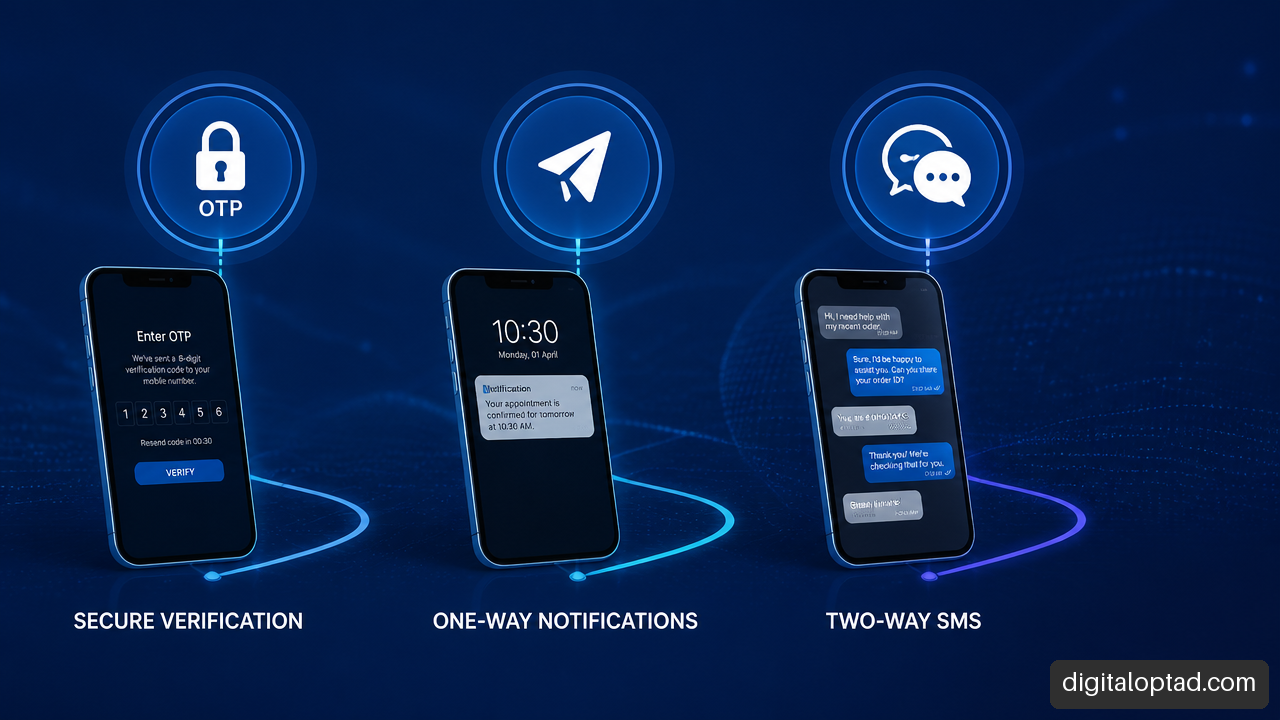
Illustration representing three types of SMS: OTP verification, one-way outbound SMS, and interactive two-way SMS communication.

Table of Contents

• Key Takeaways
• Understanding the Core Types of SMS: OTP, One-Way SMS and Two-Way SMS
• Comparing the Mechanics: Transport, Direction, and Purpose
• Technical Infrastructure and Sender ID Rules in South Africa
• Selecting the Right SMS Flow for Your Business Workflows
• Integrating Business SMS with Digital Optad Systems
• Frequently Asked Questions
• Sources and References

Key Takeaways

• SMS OTP (One-Time Password) is a payload type designed specifically for authentication, delivering short-lived, single-session numeric codes to verify user identity.
• One-Way SMS is an outbound-only transport mechanism used for broadcasting operational notifications, security alerts, order updates, and marketing messages without taking replies.
• Two-Way SMS enables conversational, interactive communication by utilizing virtual long numbers or short codes to capture customer responses and feed them into backend systems.
• Transport vs. Content: SMS OTP represents the message content pattern, while one-way and two-way SMS represent the transport capabilities of the underlying cellular channel.
• Regional Telecom Rules: In South Africa, numeric sender IDs, alphanumeric branding, and virtual long numbers each carry distinct network routing requirements and cost structures.
• Workflow Automation: Connecting your messaging channel to web platforms, forms, and databases via continuous system integration ensures maximum delivery reliability and user engagement.

Understanding the Core Types of SMS: OTP, One-Way SMS and Two-Way SMS

To make informed decisions regarding mobile communication, we must first separate the purpose of a message from how the message travels across cellular networks. Many business teams treat authentication passcodes, status updates, and interactive customer chats as identical broadcast tools. However, each channel serves a distinct functional purpose and imposes unique engineering requirements.

Unpacking SMS OTP (One-Time Password)

SMS OTP refers to a security protocol where a business sends a temporary, numeric verification code to a user's mobile device via text message. As detailed in MDN Web Docs authentication specs, an OTP acts as a single-login-attempt code delivered directly to a user's phone during sign-in to confirm physical possession of the registered mobile number.

We frequently deploy SMS OTP flows for critical security checkpoints, including:

  1. Account creation and mobile phone number verification.

  2. Multi-factor authentication (MFA) during user sign-in.

  3. High-value transaction authorizations and bank transfer approvals.

  4. Self-service account recovery and password resets.

According to ClickSend's guide to 2FA passcodes, an SMS OTP is time-sensitive, bound to a single session, and forms part of a multi-factor authentication strategy rather than acting as a standalone security architecture. These codes typically expire within 2 to 5 minutes to prevent replay attacks. Because an OTP is strictly designed for automated verification, users are not expected to reply to the text message directly; instead, they enter the numeric code into your app or web form.

Exploring One-Way SMS Workflows

One-way SMS is an outbound-only transmission method. When an enterprise sends a one-way text message, the network transmits the message from the system to the subscriber's handset, but the channel does not accept or route inbound customer replies. As explained in BSG's glossary guide on one-way messaging, one-way SMS cannot be replied to, making it ideal for notifications, whereas two-way SMS actively supports customer responses.

Typical use cases for one-way SMS include:
• Sending dispatch notices, delivery tracking updates, and appointment reminders.
• Broadcasting urgent staff announcements and operational system status alerts.
• Delivering time-critical dispatch codes or transactional verification receipts.
• Running targeted promotional broadcasts and seasonal discount announcements.

Because one-way messaging eliminates the backend complexity of monitoring incoming replies, it provides a cost-effective, high-throughput solution for broadcasting information quickly to large audiences. In many global markets, businesses utilize customized alphanumeric sender IDs (such as your company brand name) for one-way communications.

Mastering Two-Way SMS Dialogues

Two-way SMS establishes a bidirectional communication channel between your company and your customers. Instead of sending an unanswerable alert, two-way messaging provisions phone numbers capable of capturing incoming text responses and routing them directly to your software systems or customer support dashboard.

Common business scenarios that rely on two-way SMS include:
• Interactive appointment scheduling, where users reply "1" to confirm or "2" to reschedule.
• Real-time customer support triage, allowing agents to text back and forth with clients.
• Instant customer satisfaction surveys, NPS scoring, and feedback collection.
• Double opt-in marketing confirmations and keyword-driven information requests.
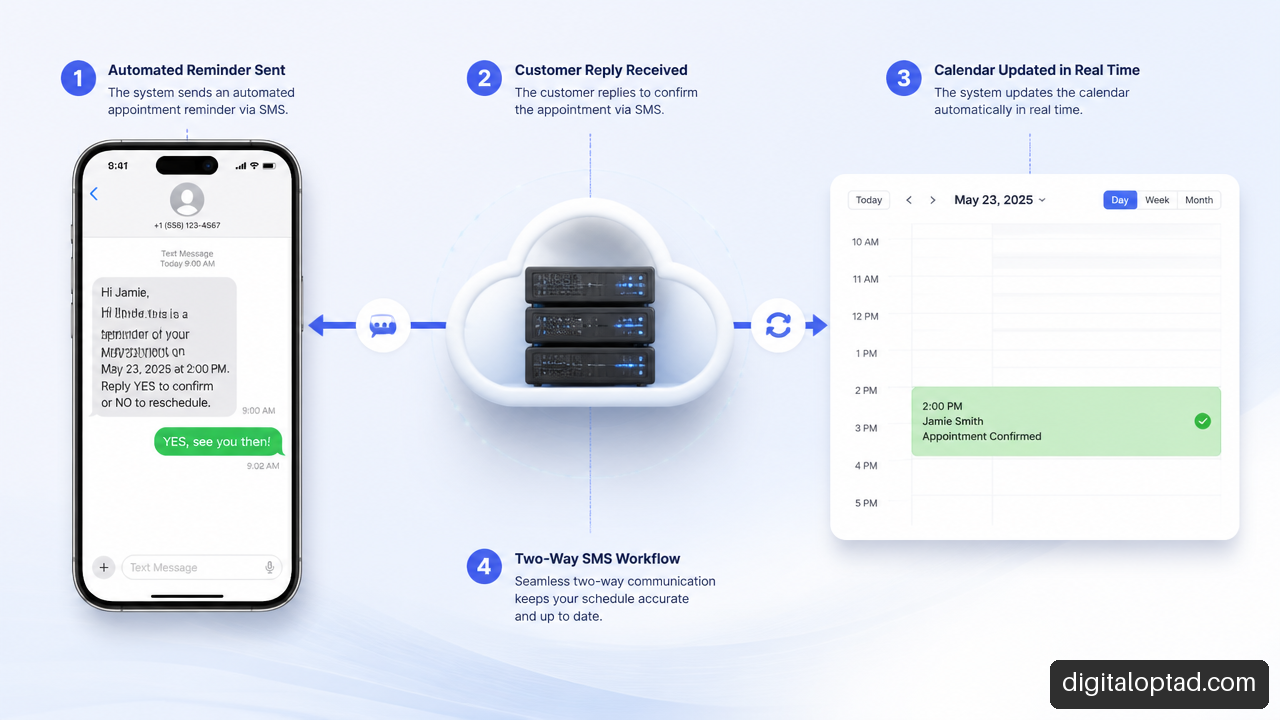
Diagram showing the workflow of a two-way SMS message updating a database based on customer text reply.

Two-way messaging transforms passive broadcasts into active conversations. By integrating conversational response tracking with your database, your platforms can process inbound replies automatically, updating customer profiles or triggering secondary actions without human intervention.

Comparing the Mechanics: Transport, Direction, and Purpose

Understanding the differences between Types of SMS: OTP, one-way SMS and two-way SMS requires separating content patterns from transport directionality. A common misconception among technical teams is treating OTP as an entirely separate channel from one-way SMS. In reality, OTP is a specific type of message content, whereas one-way and two-way SMS describe the directional capabilities of the cellular connection.

Transactional vs. Promotional Message Classifications

Mobile network operators classify text messages into two primary categories, regardless of whether they are one-way or two-way:

  1. Transactional SMS: Essential, non-marketing communications requested or expected by the user. Examples include OTP codes, appointment reminders, flight updates, and payment receipts. These messages carry strict deliverability priorities and are generally exempt from standard opt-out keyword requirements, provided they serve a pure utility function.

  2. Promotional SMS: Marketing messages, sales announcements, and promotional offers designed to drive customer engagement. As documented in Infobip's documentation on communication options, one-way and two-way SMS can both be split into transactional and promotional categories depending on whether the flow is meant for alerts, OTPs, or interactive marketing feedback.

Transport Mechanics vs. Content Delivery

An OTP is almost universally transmitted over a one-way transactional SMS channel. When your web backend requests a passcode delivery, it routes a message containing the generated secret code across a one-way pipeline. The recipient receives the text, views the numbers, and inputs them into your digital interface. The user does not reply to the text message itself.

However, in specialized workflows, a platform might implement a two-way OTP process—for example, asking a customer to text a specific code back to a dedicated short code to approve a bank transfer. In most enterprise scenarios, maintaining an outbound one-way pipeline for passcodes remains the standard industry approach.

Comprehensive Comparison Table

To help you evaluate these options side by side, we have summarized their operational characteristics below:

Feature / Dimension

SMS OTP

One-Way SMS

Two-Way SMS

Primary Direction

Outbound only (Payload pattern)

Outbound only (Transport)

Outbound and Inbound (Bidirectional)

Core Purpose

Identity verification & session authentication

Mass notifications, alerts, & announcements

Dialogues, support, & interactive confirmations

Inbound Reply Capability

No (User enters code into website/app)

No (Replies are dropped or blocked)

Yes (Inbound text is routed to application)

Typical Sender Identifier

Alphanumeric Sender ID or System Numeric ID

Alphanumeric Sender ID or Standard Long Code

Virtual Long Number (VLN) or Short Code

Typical Expiry Window

Very Short (1 to 5 minutes)

Medium to Long (Informational context)

Long-term dedicated channel

System Complexity

High backend logic (Generation/Validation)

Low to Medium (Outbound queue management)

High (Requires state tracking & inbound hooks)

Typical Use Cases

Login MFA, Password Reset, Banking Approvals

Delivery Alerts, Marketing Broadcasts, System Status

Support Desk, Survey Responses, Booking Confirmations

Technical Infrastructure and Sender ID Rules in South Africa

When deploying business SMS South Africa solutions, companies must navigate specific regional telecom regulations and network operator behaviors. Cellular networks in South Africa handle message routing, sender presentation, and reply processing differently depending on the chosen sender format.

Alphanumeric Sender IDs and Numeric Assignments

An Alphanumeric Sender ID allows a business to replace a standard phone number with a custom text label, such as your brand name (e.g., "MyCompany"). This provides instant recognition and increases open rates for outbound alerts. However, network rules governing sender identification carry important operational caveats:

• One-Way Operational Restriction: Alphanumeric Sender IDs are inherently one-way. Mobile networks cannot route reply text messages back to a word or brand name.
• Dynamic Numeric Assignment: In South Africa, mobile network operators frequently strip or rewrite unapproved custom sender IDs, delivering the text from an automatically assigned system numeric sender. Consequently, the displayed sender number on the customer's phone may change from one message to the next.
• No Reply Expectation: Because the displayed origin number might be an automatically generated system address, recipients attempting to reply will experience delivery failure. Clear call-to-action text inside the message body is essential to guide the recipient on how to respond.

Virtual Long Numbers (VLNs) and Short Codes

To implement reliable two-way messaging, organizations must utilize dedicated inbound-capable number formats:

  1. Virtual Long Numbers (VLNs): Standard 10-digit phone numbers (such as local mobile ranges) configured on an SMS gateway. VLNs provide an affordable way to establish two-way communication for customer support and individual message tracking. They allow customers to send replies at standard mobile rates.

  2. Short Codes: Dedicated 5-digit numbers designed for high-volume messaging campaigns. Short codes are easy for consumers to remember and are commonly used for TV competitions, opt-in programs, and corporate feedback lines. Short codes can be configured as standard-rate, toll-free, or premium-rated numbers.

  3. Cost Considerations: Provisioning dedicated short codes or virtual long numbers involves monthly rental fees, setup charges, and specific carrier line fees that go beyond the basic per-message delivery cost.

Routing, Rate Limits and Network Operator Rules

Delivering high volumes of text messages across South African mobile networks requires careful attention to throughput capacity and rate limits. Sending thousands of authentication passcodes simultaneously over unoptimized connections can cause network congestion, resulting in delayed code delivery.

When an OTP is delayed by even 60 seconds, users often request additional codes or abandon the login process entirely. To maintain delivery speeds under 5 seconds, enterprise platforms utilize intelligent routing across multiple direct network connections, automatically re-routing traffic if a specific operator experiences localized latency.

Selecting the Right SMS Flow for Your Business Workflows

Choosing between OTP, one-way SMS, and two-way SMS depends on analyzing your functional objectives, security considerations, and budget allocations. Selecting an unnecessarily complex setup increases operational overhead, while choosing an overly simplified path can hurt the user experience.

Security, Authentication and Fraud Prevention

If your priority is verifying user identities, confirming phone number ownership, or protecting sensitive account actions, SMS OTP is the proper mechanism. As noted by LoginRadius's breakdown of SMS OTP, delivering a short-lived passcode via text serves as a widely recognized two-factor authentication method for identity verification.

However, engineering teams must account for known security risks, such as SIM-swap fraud and mobile network interception. To maintain robust application security, we recommend applying the following operational guidelines:
• Set Short Expiry Windows: Enforce a strict 2- to 3-minute validity limit on all generated passcodes to minimize the risk of unauthorized use.
• Implement Resend Rate Limits: Restrict users from requesting more than 3 consecutive OTPs within a 10-minute window to prevent API abuse and SMS pumping fraud.
• Provide Alternative Verification Fallbacks: Offer multi-channel fallback options, such as automated voice calls, email verification, or authenticator app prompts, when cellular delivery encounters delays.

Customer Service, Scheduling and Support Triage

For service teams managing client interactions, appointment bookings, or feedback loops, two-way SMS provides a direct communication channel. Rather than forcing customers to download specialized mobile apps or log into complex web portals, you can send direct text prompts that allow immediate replies.

For instance, a medical practice can send an automated appointment reminder 24 hours in advance: "Hi Jane, your appointment is scheduled for tomorrow at 10:00 AM. Reply 1 to Confirm, or 2 to Reschedule." When the patient replies with "1", the two-way gateway captures the incoming text, parses the decision, updates the practice management database, and sends an automated confirmation message.

To discover how dedicated automation improves these customer touchpoints, explore our custom solutions for Automation Confirmation SMS workflows.

Marketing Campaigns and Opt-In Compliance

When running promotional campaigns or brand announcements, deciding between one-way and two-way SMS depends on your campaign strategy and regulatory requirements:
• Use One-Way SMS when broadcasting large-scale promotional announcements, discount vouchers, or event reminders where no direct dialogue is needed. Make sure to include a clear opt-out mechanism (such as an unsubscribe web link or dedicated opt-out number) to comply with data privacy laws.
• Use Two-Way SMS when running interactive marketing campaigns, such as keyword contests ("Text WIN to 33901"), lead generation surveys, or instant opt-in registrations.

To evaluate full-featured communication strategies tailored to your business, browse our comprehensive All-in-1 SMS solutions.

Integrating Business SMS with Digital Optad Systems

Deploying SMS notifications effectively requires connecting text communication directly with your existing core software infrastructure. Sending manual messages from an isolated dashboard creates operational bottlenecks, introduces human error, and delays execution.

At Digital Optad, we serve as an SMS service and systems-integration partner, linking automated text messaging capabilities directly to your websites, web forms, web applications, customer databases, and enterprise resource planning systems.

Webhooks, API Triggers and Database Synchronization

By leveraging modern REST APIs and event-driven webhooks, we help organizations automate their messaging triggers across every customer touchpoint:
• Automated Registration Confirmations: Instantly trigger an SMS verification code the moment a prospective user submits a registration form on your web app.
• Real-Time Order Status Updates: Sync your e-commerce or logistics database to fire one-way SMS notifications whenever a package changes status or ships out.
• Instant Lead Generation Follow-Ups: Automatically send a welcome text message to incoming website leads, opening a two-way channel for your sales team.
• Internal Staff Alerts: Notify technical support staff or field technicians instantly via automated text when system errors or urgent tasks arise.

If you are searching for scalable cloud-based tools to power your customer communication, take a look at our specialized Online SMS services.

Handling Inbound State, Error Recovery and Fallbacks

Building a resilient SMS integration requires handling edge cases, message delivery delays, and failed transmission attempts seamlessly:

  1. Inbound State Tracking: In two-way SMS workflows, your backend must track conversational state. When an incoming reply arrives from a customer's phone number, the integration engine matches that number against active database sessions to correctly attribute the reply to the right context.

  2. Handling Delivery Failures: Cellular network congestion or turned-off handsets can occasionally prevent text delivery. We configure intelligent system fallbacks, such as re-attempting delivery through secondary routes or triggering email notifications if an OTP remains unreceived after a set timeout.

  3. Compliance and Privacy Controls: Integrating opt-out keyword detection (such as automatically processing "STOP" requests) directly into your database keeps your messaging campaigns compliant with national privacy frameworks and telecommunication standards.

Whether you need to install rapid OTP verification for your software platform, configure one-way dispatch alerts, or design a fully automated two-way support engine, Digital Optad provides the end-to-end strategy, custom code development, and hosting infrastructure needed to achieve measurable operational results.

Frequently Asked Questions

What is the primary difference between OTP, one-way SMS, and two-way SMS?

SMS OTP is a specialized message payload containing a temporary security code used to authenticate users during logins or transactions. One-way SMS is an outbound-only transmission channel used for alerts, reminders, and broadcasts without receiving replies. Two-way SMS is a bidirectional channel that allows businesses to send messages and receive responses from customers using virtual long numbers or short codes.

Is SMS OTP always delivered over a one-way SMS channel?

Yes, in the vast majority of application architectures, an SMS OTP is delivered using an outbound, one-way transactional SMS pipeline. The recipient receives the numeric verification code in their text inbox and types it directly into a website or mobile application form, rather than replying to the text message.

Why can't customers reply to a one-way SMS message?

One-way SMS messages are frequently transmitted using alphanumeric sender IDs (such as a company brand name) or dynamically assigned system routing numbers. Cellular network protocols cannot route return text messages back to an alphanumeric string or temporary system number, causing any reply attempts from the customer's phone to fail.

What sender format is best for two-way SMS in South Africa?

Two-way SMS requires a dedicated reply-capable destination address. In South Africa, organizations typically use Virtual Long Numbers (VLNs) for lower-volume customer service conversations and appointment confirmations, or 5-digit Short Codes for high-volume marketing opt-ins, national competitions, and interactive campaigns.

How fast should an SMS OTP be delivered to avoid user drop-off?

An SMS OTP should ideally arrive on the user's handset within 3 to 10 seconds. Delays exceeding 30 seconds lead to high user frustration, repeated code requests, and abandoned login sessions. Optimizing direct network routes and establishing low-latency gateway integration helps maintain high delivery speeds.

What should my application do if a user does not receive their OTP text?

Your application should provide a clear, user-friendly fallback path. After waiting 45 to 60 seconds, offer options to resend the code via SMS, deliver the verification passcode via an automated voice phone call, or send the code to the user's registered email address.

Do one-way marketing SMS messages require an opt-out option?

Yes, commercial and promotional SMS messages must adhere to telecommunication standards and consumer privacy laws. Even when using a one-way broadcast format, you must provide recipients with a clear method to opt out, such as a web opt-out link or a dedicated opt-out number stated in the message text.

How does Digital Optad integrate business SMS into existing websites and software?

Digital Optad connects SMS gateways directly to your digital software using custom API integration, webhooks, and secure cloud hosting. We link your web forms, registration pipelines, databases, and administrative platforms to automated messaging triggers, ensuring real-time notification delivery and stateful two-way response management.

Sources and References

• MDN Web Docs: One-time passwords (OTP)
• LoginRadius: SMS OTP Overview
• ClickSend: SMS OTP – 2 Factor Authentication
• BSG World: What is One-Way SMS?
• Infobip: SMS Communication Options
Put the insight into practice

Need help turning a digital challenge into a working solution?

Tell us what is disconnected, manual or difficult to manage. Digital Optad can help you design, build and connect the right digital environment.

Discuss your project

Continue exploring

Related insights

More practical guidance for building and improving your connected digital environment.

AI Agents and Chatbots: A Practical Guide for Organizations
Integration
11 September 2026Digital Optad

AI Agents and Chatbots: A Practical Guide for Organizations

Read article
Cookie Consent, Website Accessibility, and Digital Compliance Guide
10 September 2026Digital Optad

Cookie Consent, Website Accessibility, and Digital Compliance Guide

Read article
Email, SMS & OTP Solutions for Secure Digital Systems
9 September 2026Digital Optad

Email, SMS & OTP Solutions for Secure Digital Systems

Read article

Digital Optad Updates

Stay informed

Subscribe for practical insights, company updates and information about connected digital systems.

Subscribe
DODigitalOptad

Digital Optad is an ICT company that designs, develops, integrates, hosts and supports connected digital environments built around real organisational processes.

contactus@digitaloptad.com+27 73 839 9465
Makhanda, Eastern Cape, South Africa

Digital solutions

Websites & e-commerceApplications & portalsSystems integrationDatabases & dashboardsForms & automationWhatsApp agentsEmail & SMS

Infrastructure & support

Website hostingBusiness emailMaintenance & supportSystem trainingSecurity & performanceConsent managementWebsite accessibility

Digital Optad

All servicesCore capabilitiesHow we workSolution areasMedia servicesBlogContact

Looking for another digital service?

Explore the complete service catalogue, including browser extensions, privacy configuration, SEO, GEO, content strategy and visibility monitoring.

View all services

TV Stream Media

Managed social media, content production, audience-media collection, live streaming, multistreaming and online television services supported by Digital Optad’s technology.

Explore media services

Clients purchase managed media outcomes and receive agreed access where necessary. They do not purchase ownership of the underlying software platforms.

© 2026 Digital Optad. All rights reserved.

Build · Connect · Host · Protect · Grow

    We respect your privacy

    We and our partners store and/or access information on your device (e.g. cookies) and process personal data. We and 1 vendor listed in the IAB Global Vendor List as well as 5 additional partners may process this data. This may include IP addresses, usage identifiers, browsing behaviour, and device identifiers.

    Purposes:
    • Store and/or access information on a device
    • Use limited data to select advertising
    • Create profiles for personalised advertising
    • Use profiles to select personalised advertising
    • Create profiles to personalise content
    • Use profiles to select personalised content
    • Measure advertising performance
    • Measure content performance
    • Understand audiences through statistics or combinations of data from different sources
    • Develop and improve services
    • Use limited data to select content

    Special Features:
    • Use precise geolocation data
    • Identify devices based on information actively requested

    Your consent applies to this website only. You can change or withdraw your consent at any time via Settings. Some partners process your data on the basis of legitimate interest, which you have the right to object to. Manage legitimate interests

    Privacy Policy

    Settings

    ▼ Store and/or access information on a device
    Cookies, device or similar online identifiers (e.g. login-based identifiers, randomly assigned identifiers, network based identifiers) together with other information (e.g. browser type and information, language, screen size, supported technologies etc.) can be stored or read on your device to recognise it each time it connects to an app or to a website, for one or several of the purposes presented here.
    💡 Most purposes explained in this notice rely on the storage or accessing of information from your device when you use an app or visit a website. For example, a vendor or publisher might need to store a cookie on your device during your first visit on a website, to be able to recognise your device during your next visits (by accessing this cookie each time).
    📊 1 vendors
    ▼ Use limited data to select advertising
    Advertising presented to you on this service can be based on limited data, such as the website or app you are using, your non-precise location, your device type or which content you are (or have been) interacting with (for example, to limit the number of times an ad is presented to you).
    💡 A car manufacturer wants to promote its electric vehicles to environmentally conscious users living in the city after office hours. The advertising is presented on a page with related content (such as an article on climate change actions) after 6:30 p.m. to users whose non-precise location suggests that they are in an urban zone.
    💡 A large producer of watercolour paints wants to carry out an online advertising campaign for its latest watercolour range, diversifying its audience to reach as many amateur and professional artists as possible and avoiding showing the ad next to mismatched content (for instance, articles about how to paint your house). The number of times that the ad has been presented to you is detected and limited, to avoid presenting it too often.
    📊 1 vendors
    Legitimate Interest
    ▼ Create profiles for personalised advertising
    Information about your activity on this service (such as forms you submit, content you look at) can be stored and combined with other information about you (for example, information from your previous activity on this service and other websites or apps) or similar users. This is then used to build or improve a profile about you (that might include possible interests and personal aspects). Your profile can be used (also later) to present advertising that appears more relevant based on your possible interests by this and other entities.
    💡 If you read several articles about the best bike accessories to buy, this information could be used to create a profile about your interest in bike accessories. Such a profile may be used or improved later on, on the same or a different website or app to present you with advertising for a particular bike accessory brand. If you also look at a configurator for a vehicle on a luxury car manufacturer website, this information could be combined with your interest in bikes to refine your profile and make an assumption that you are interested in luxury cycling gear.
    💡 An apparel company wishes to promote its new line of high-end baby clothes. It gets in touch with an agency that has a network of clients with high income customers (such as high-end supermarkets) and asks the agency to create profiles of young parents or couples who can be assumed to be wealthy and to have a new child, so that these can later be used to present advertising within partner apps based on those profiles.
    📊 1 vendors
    Legitimate Interest
    ▼ Use profiles to select personalised advertising
    Advertising presented to you on this service can be based on your advertising profiles, which can reflect your activity on this service or other websites or apps (like the forms you submit, content you look at), possible interests and personal aspects.
    💡 An online retailer wants to advertise a limited sale on running shoes. It wants to target advertising to users who previously looked at running shoes on its mobile app. Tracking technologies might be used to recognise that you have previously used the mobile app to consult running shoes, in order to present you with the corresponding advertisement on the app.
    💡 A profile created for personalised advertising in relation to a person having searched for bike accessories on a website can be used to present the relevant advertisement for bike accessories on a mobile app of another organisation.
    📊 1 vendors
    Legitimate Interest
    ▼ Create profiles to personalise content
    Information about your activity on this service (for instance, forms you submit, non-advertising content you look at) can be stored and combined with other information about you (such as your previous activity on this service or other websites or apps) or similar users. This is then used to build or improve a profile about you (which might for example include possible interests and personal aspects). Your profile can be used (also later) to present content that appears more relevant based on your possible interests, such as by adapting the order in which content is shown to you, so that it is even easier for you to find content that matches your interests.
    💡 You read several articles on how to build a treehouse on a social media platform. This information might be added to a profile to mark your interest in content related to outdoors as well as do-it-yourself guides (with the objective of allowing the personalisation of content, so that for example you are presented with more blog posts and articles on treehouses and wood cabins in the future).
    💡 You have viewed three videos on space exploration across different TV apps. An unrelated news platform with which you have had no contact builds a profile based on that viewing behaviour, marking space exploration as a topic of possible interest for other videos.
    📊 0 vendors
    Legitimate Interest
    ▼ Use profiles to select personalised content
    Content presented to you on this service can be based on your content personalisation profiles, which can reflect your activity on this or other services (for instance, the forms you submit, content you look at), possible interests and personal aspects. This can for example be used to adapt the order in which content is shown to you, so that it is even easier for you to find (non-advertising) content that matches your interests.
    💡 You read articles on vegetarian food on a social media platform and then use the cooking app of an unrelated company. The profile built about you on the social media platform will be used to present you vegetarian recipes on the welcome screen of the cooking app.
    💡 You have viewed three videos about rowing across different websites. An unrelated video sharing platform will recommend five other videos on rowing that may be of interest to you when you use your TV app, based on a profile built about you when you visited those different websites to watch online videos.
    📊 0 vendors
    Legitimate Interest
    ▼ Measure advertising performance
    Information regarding which advertising is presented to you and how you interact with it can be used to determine how well an advert has worked for you or other users and whether the goals of the advertising were reached. For instance, whether you saw an ad, whether you clicked on it, whether it led you to buy a product or visit a website, etc. This is very helpful to understand the relevance of advertising campaigns.
    💡 You have clicked on an advertisement about a “black Friday” discount by an online shop on the website of a publisher and purchased a product. Your click will be linked to this purchase. Your interaction and that of other users will be measured to know how many clicks on the ad led to a purchase.
    💡 You are one of very few to have clicked on an advertisement about an “international appreciation day” discount by an online gift shop within the app of a publisher. The publisher wants to have reports to understand how often a specific ad placement within the app, and notably the “international appreciation day” ad, has been viewed or clicked by you and other users, in order to help the publisher and its partners (such as agencies) optimise ad placements.
    📊 1 vendors
    Legitimate Interest
    ▼ Measure content performance
    Information regarding which content is presented to you and how you interact with it can be used to determine whether the (non-advertising) content e.g. reached its intended audience and matched your interests. For instance, whether you read an article, watch a video, listen to a podcast or look at a product description, how long you spent on this service and the web pages you visit etc. This is very helpful to understand the relevance of (non-advertising) content that is shown to you.
    💡 You have read a blog post about hiking on a mobile app of a publisher and followed a link to a recommended and related post. Your interactions will be recorded as showing that the initial hiking post was useful to you and that it was successful in interesting you in the related post. This will be measured to know whether to produce more posts on hiking in the future and where to place them on the home screen of the mobile app.
    💡 You were presented a video on fashion trends, but you and several other users stopped watching after 30 seconds. This information is then used to evaluate the right length of future videos on fashion trends.
    📊 0 vendors
    Legitimate Interest
    ▼ Understand audiences through statistics or combinations of data from different sources
    Reports can be generated based on the combination of data sets (like user profiles, statistics, market research, analytics data) regarding your interactions and those of other users with advertising or (non-advertising) content to identify common characteristics (for instance, to determine which target audiences are more receptive to an ad campaign or to certain contents).
    💡 The owner of an online bookstore wants commercial reporting showing the proportion of visitors who consulted and left its site without buying, or consulted and bought the last celebrity autobiography of the month, as well as the average age and the male/female distribution of each category. Data relating to your navigation on its site and to your personal characteristics is then used and combined with other such data to produce these statistics.
    💡 An advertiser wants to better understand the type of audience interacting with its adverts. It calls upon a research institute to compare the characteristics of users who interacted with the ad with typical attributes of users of similar platforms, across different devices. This comparison reveals to the advertiser that its ad audience is mainly accessing the adverts through mobile devices and is likely in the 45-60 age range.
    📊 1 vendors
    Legitimate Interest
    ▼ Develop and improve services
    Information about your activity on this service, such as your interaction with ads or content, can be very helpful to improve products and services and to build new products and services based on user interactions, the type of audience, etc. This specific purpose does not include the development or improvement of user profiles and identifiers.
    💡 A technology platform working with a social media provider notices a growth in mobile app users, and sees based on their profiles that many of them are connecting through mobile connections. It uses a new technology to deliver ads that are formatted for mobile devices and that are low-bandwidth, to improve their performance.
    💡 An advertiser is looking for a way to display ads on a new type of consumer device. It collects information regarding the way users interact with this new kind of device to determine whether it can build a new mechanism for displaying advertising on this type of device.
    📊 1 vendors
    Legitimate Interest
    ▼ Use limited data to select content
    Content presented to you on this service can be based on limited data, such as the website or app you are using, your non-precise location, your device type, or which content you are (or have been) interacting with (for example, to limit the number of times a video or an article is presented to you).
    💡 A travel magazine has published an article on its website about the new online courses proposed by a language school, to improve travelling experiences abroad. The school’s blog posts are inserted directly at the bottom of the page, and selected on the basis of your non-precise location (for instance, blog posts explaining the course curriculum for different languages than the language of the country you are situated in).
    💡 A sports news mobile app has started a new section of articles covering the most recent football games. Each article includes videos hosted by a separate streaming platform showcasing the highlights of each match. If you fast-forward a video, this information may be used to select a shorter video to play next.
    📊 0 vendors
    Legitimate Interest
    Special Purposes
    ▼ Ensure security, prevent and detect fraud, and fix errors
    Always active
    Your data can be used to monitor for and prevent unusual and possibly fraudulent activity (for example, regarding advertising, ad clicks by bots), and ensure systems and processes work properly and securely. It can also be used to correct any problems you, the publisher or the advertiser may encounter in the delivery of content and ads and in your interaction with them.
    💡 An advertising intermediary delivers ads from various advertisers to its network of partnering websites. It notices a large increase in clicks on ads relating to one advertiser, and uses data regarding the source of the clicks to determine that 80% of the clicks come from bots rather than humans.
    ▼ Deliver and present advertising and content
    Always active
    Certain information (like an IP address or device capabilities) is used to ensure the technical compatibility of the content or advertising, and to facilitate the transmission of the content or ad to your device.
    💡 Clicking on a link in an article might normally send you to another page or part of the article. To achieve this, 1°) your browser sends a request to a server linked to the website, 2°) the server answers back (“here is the article you asked for”), using technical information automatically included in the request sent by your device, to properly display the information / images that are part of the article you asked for. Technically, such exchange of information is necessary to deliver the content that appears on your screen.
    ▼ Save and communicate privacy choices
    Always active
    The choices you make regarding the purposes and entities listed in this notice are saved and made available to those entities in the form of digital signals (such as a string of characters). This is necessary in order to enable both this service and those entities to respect such choices.
    💡 When you visit a website and are offered a choice between consenting to the use of profiles for personalised advertising or not consenting, the choice you make is saved and made available to advertising providers, so that advertising presented to you respects that choice.
    Features
    These means of processing can be used solely in pursuit of one or several purposes for which you are given a choice in this notice.
    ▼ Match and combine data from other data sources
    Always active
    Information about your activity on this service may be matched and combined with other information relating to you and originating from various sources (for instance your activity on a separate online service, your use of a loyalty card in-store, or your answers to a survey), in support of the purposes explained in this notice.
    💡 You used your loyalty card when purchasing sunglasses at a local boutique. If you later browse content relating to summer travel, this information may be combined with your previous purchase recorded by the boutique’s loyalty program to present you with ads for swimsuits or other beach accessories.
    📊 1 vendors
    ▼ Link different devices
    Always active
    In support of the purposes explained in this notice, your device might be considered as likely linked to other devices that belong to you or your household (for instance because you are logged in to the same service on both your phone and your computer, or because you may use the same Internet connection on both devices).
    💡 You visited an online retailer website from your computer to look at mystery books and you consented to your data being used to create profiles for personalised advertising. If you later browse on your phone using the same Wifi, a vendor may infer you have been using both devices and you may be presented with an ad about the same mystery books in the mobile app you are using, but only if you have consented to receiving personalised advertising on this app.
    📊 1 vendors
    ▼ Identify devices based on information transmitted automatically
    Always active
    Your device might be distinguished from other devices based on information it automatically sends when accessing the Internet (for instance, the IP address of your Internet connection or the type of browser you are using) in support of the purposes exposed in this notice.
    💡 When you see an ad in your weather forecast app, some technical details that your device always transmits when accessing the Internet (such as the IP address of your Wifi and the version of your device’s operating system) can be used for instance to limit the number of times you see the same ad in other apps.
    📊 1 vendors
    Special Features
    ▼ Use precise geolocation data
    With your acceptance, your precise location (within a radius of less than 500 metres) may be used in support of the purposes explained in this notice.
    📊 0 vendors
    ▼ Identify devices based on information actively requested
    With your acceptance, certain characteristics specific to your device might be requested and used to distinguish it from other devices (such as the installed fonts or plugins, the resolution of your screen) in support of the purposes explained in this notice.
    📊 0 vendors

    Your choices about vendors apply only to purposes and special features.

    You cannot object here to the processing of your personal data for special purposes.

    Special features may be used for the special purpose Ensure security, prevent and detect fraud, and fix errors regardless of your choice about special features.

    Some partners process your data on the basis of legitimate interest, which you have the right to object to.
    This may include IP addresses, usage identifiers, browsing behaviour, and device identifiers.
    Your consent applies to this website only.
    Legitimate Interest: Purposes
    ▼ Use limited data to select advertising
    Advertising presented to you on this service can be based on limited data, such as the website or app you are using, your non-precise location, your device type or which content you are (or have been) interacting with (for example, to limit the number of times an ad is presented to you).
    💡 A car manufacturer wants to promote its electric vehicles to environmentally conscious users living in the city after office hours. The advertising is presented on a page with related content (such as an article on climate change actions) after 6:30 p.m. to users whose non-precise location suggests that they are in an urban zone.
    💡 A large producer of watercolour paints wants to carry out an online advertising campaign for its latest watercolour range, diversifying its audience to reach as many amateur and professional artists as possible and avoiding showing the ad next to mismatched content (for instance, articles about how to paint your house). The number of times that the ad has been presented to you is detected and limited, to avoid presenting it too often.
    1 vendors
    ▼ Measure advertising performance
    Information regarding which advertising is presented to you and how you interact with it can be used to determine how well an advert has worked for you or other users and whether the goals of the advertising were reached. For instance, whether you saw an ad, whether you clicked on it, whether it led you to buy a product or visit a website, etc. This is very helpful to understand the relevance of advertising campaigns.
    💡 You have clicked on an advertisement about a “black Friday” discount by an online shop on the website of a publisher and purchased a product. Your click will be linked to this purchase. Your interaction and that of other users will be measured to know how many clicks on the ad led to a purchase.
    💡 You are one of very few to have clicked on an advertisement about an “international appreciation day” discount by an online gift shop within the app of a publisher. The publisher wants to have reports to understand how often a specific ad placement within the app, and notably the “international appreciation day” ad, has been viewed or clicked by you and other users, in order to help the publisher and its partners (such as agencies) optimise ad placements.
    1 vendors
    ▼ Understand audiences through statistics or combinations of data from different sources
    Reports can be generated based on the combination of data sets (like user profiles, statistics, market research, analytics data) regarding your interactions and those of other users with advertising or (non-advertising) content to identify common characteristics (for instance, to determine which target audiences are more receptive to an ad campaign or to certain contents).
    💡 The owner of an online bookstore wants commercial reporting showing the proportion of visitors who consulted and left its site without buying, or consulted and bought the last celebrity autobiography of the month, as well as the average age and the male/female distribution of each category. Data relating to your navigation on its site and to your personal characteristics is then used and combined with other such data to produce these statistics.
    💡 An advertiser wants to better understand the type of audience interacting with its adverts. It calls upon a research institute to compare the characteristics of users who interacted with the ad with typical attributes of users of similar platforms, across different devices. This comparison reveals to the advertiser that its ad audience is mainly accessing the adverts through mobile devices and is likely in the 45-60 age range.
    1 vendors
    ▼ Develop and improve services
    Information about your activity on this service, such as your interaction with ads or content, can be very helpful to improve products and services and to build new products and services based on user interactions, the type of audience, etc. This specific purpose does not include the development or improvement of user profiles and identifiers.
    💡 A technology platform working with a social media provider notices a growth in mobile app users, and sees based on their profiles that many of them are connecting through mobile connections. It uses a new technology to deliver ads that are formatted for mobile devices and that are low-bandwidth, to improve their performance.
    💡 An advertiser is looking for a way to display ads on a new type of consumer device. It collects information regarding the way users interact with this new kind of device to determine whether it can build a new mechanism for displaying advertising on this type of device.
    1 vendors
    Special Purposes
    ▼ Ensure security, prevent and detect fraud, and fix errors
    Always active
    Your data can be used to monitor for and prevent unusual and possibly fraudulent activity (for example, regarding advertising, ad clicks by bots), and ensure systems and processes work properly and securely. It can also be used to correct any problems you, the publisher or the advertiser may encounter in the delivery of content and ads and in your interaction with them.
    💡 An advertising intermediary delivers ads from various advertisers to its network of partnering websites. It notices a large increase in clicks on ads relating to one advertiser, and uses data regarding the source of the clicks to determine that 80% of the clicks come from bots rather than humans.
    1 vendors
    ▼ Deliver and present advertising and content
    Always active
    Certain information (like an IP address or device capabilities) is used to ensure the technical compatibility of the content or advertising, and to facilitate the transmission of the content or ad to your device.
    💡 Clicking on a link in an article might normally send you to another page or part of the article. To achieve this, 1°) your browser sends a request to a server linked to the website, 2°) the server answers back (“here is the article you asked for”), using technical information automatically included in the request sent by your device, to properly display the information / images that are part of the article you asked for. Technically, such exchange of information is necessary to deliver the content that appears on your screen.
    1 vendors
    ▼ Save and communicate privacy choices
    Always active
    The choices you make regarding the purposes and entities listed in this notice are saved and made available to those entities in the form of digital signals (such as a string of characters). This is necessary in order to enable both this service and those entities to respect such choices.
    💡 When you visit a website and are offered a choice between consenting to the use of profiles for personalised advertising or not consenting, the choice you make is saved and made available to advertising providers, so that advertising presented to you respects that choice.
    1 vendors
    Legitimate Interest · Vendors (1)
    Google Advertising Products GVL #755 IAB TCF
    Privacy Policy ↗
    Consent: Purposes: Store and/or access information on a device, Create profiles for personalised advertising, Use profiles to select personalised advertising
    Legitimate Interest: Purposes: Use limited data to select advertising, Measure advertising performance, Understand audiences through statistics or combinations of data from different sources, Develop and improve services
    Special Purposes: Ensure security, prevent and detect fraud, and fix errors, Deliver and present advertising and content, Save and communicate privacy choices
    Features: Match and combine data from other data sources, Link different devices, Identify devices based on information transmitted automatically
    ⚖️ Legitimate Interest ↗
    🕐 Max. storage duration: 396 days
    💾 Also uses non-cookie storage
    View details at the vendor ↗
    📋 Data categories: IP addresses, Device characteristics, Device identifiers, Probabilistic identifiers, Authentication-derived identifiers, Browsing and interaction data, User-provided data, Non-precise location data, Users’ profiles, Privacy choices
    Retention period: 548 days
    Legitimate Interest
    Cookie Consent
    This cookie is required for the basic functionality of the website.
    Category: essential
    🕐 Retention period: Session
    Always active
    WhatsApp Business
    Meta Platforms · US
    Chat widget detected on website
    Category: functional
    Privacy Policy ↗
    calendly.com
    Cookies from calendly.com
    Category: marketing
    🕐 Retention period: Session
    Cloudflare
    Cloudflare, Inc. · Cloudflare, Inc., 101 Townsend St, San Francisco, CA 94107, USA
    This cookie is required for the basic functionality of the website.
    Category: essential
    Legal basis: Art. 6(1)(f) GDPR
    🕐 Retention period: 30 minutes
    Privacy Policy ↗
    Always active
    Google
    Google LLC · Google Ireland Limited, Gordon House, Barrow Street, Dublin 4, Ireland
    This cookie is used for advertising and tracking purposes.
    Category: functional
    Legal basis: Art. 6(1)(a) GDPR
    🕐 Retention period: 6 months
    Privacy Policy ↗
    Biscotti CMP stores your consent choice in your browser's local storage (up to 180 days).
    Consent ID: v_eyiqg1xruamv595ojl · biscotti_consent
    Look up your consent data · 12:52 UTC
    Digital Optad